25-29 July 2011
27 July 2011
I attended the first lecture of ‘Indigenous Art, Culture and Design’, presented by Mr Tony Collins.
From reading the course information guide I discovered that we are required to provide a journal byway of ‘blog’. Well I’m very happy to say that after the lecture I successfully set up a blog.28 July 2011
I attended my first tutorial and our lecturer is Ms Cheri Donaldson.
Bangara Dance Theatre: http://www.bangarra.com.au/
Bangara Dance Theatre founded by Carole Johnson in 1989, then in 1992 Stephen Page was appointed Artistic Director.Michael Riley : Artist/Photographer

Michael RILEY Untitled, from the series flyblown (blue sky with cloud), 1998, photograph, chromogenic pigment print, 113 x 87cm, purchased 2004, reproduced courtesy of the Michael Riley Foundation and VISCOPY, Australia.
Stills Gallery: http://www.stillsgallery.com.au/artists/riley/
National Gallery of Australia: http://nga.gov.au/Exhibition/RILEY/Default.cfm
The late Wiradjuri/Kamilaroi artist Michael Riley is one of the most important Indigenous artists of the past two decades. Over his career he created an impressive body of work ranging from black & white portraiture to film, video and large-scale digital photograph. Throughout, his concern was to celebrate the spirit of his people while also bearing witness to their struggles. He had a deep commitment to the process of reconciliation.Albert Namatjira (1902 - 1959) : Artist
Although Namatjira is best known for his water-colour landscapes of the Macdonnell Ranges and the nearby region, earlier in his career his imagery had included tjuringa designs, biblical themes and figurative subjects. He also produced carved and painted artefacts, and briefly painted on bean-wood panels. Superficially, his paintings give the appearance of conventional European landscapes, but Namatjira painted with 'country in mind' and continually returned to sites imbued with ancestral associations. The repetition, detailed patterning and high horizons—so characteristic of his work—blended Aboriginal and European modes of depiction.
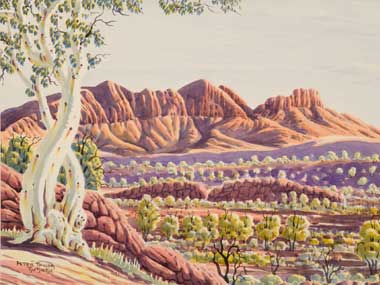 Elton Wirri Petermann Ranges 2008, Watercolour on acid free paperboard, 26 x 36 cm
Week 2
1-5 August
Lin Onus (b.1948; d.1996): Artist

Blue Leaves
Coo-ee Aboriginal Art
Edition: Screenprint/Monoprint 1/1
Code: 7843
Medium: Screenprint on paper (framed)
Size: Paper: 70 x 100 cm, Image: 70 x70 cm
Contemporary Australian artist Lin Onus was born in 1948 in Melbourne. His father, Bill, was a political activist and businessman who became the founder of the Aboriginal Advancement League and the first Aboriginal JP.
The attitude and work of Lin Onus stemmed heavily from his background. Born of an Aboriginal father and a Scottish mother, Onus endeavoured to discover his own identity by mixing the indigenous and Western styles in his own unique way. With his father being of the Yorta Yorta people from the Barmah Forest country, Onus used images from this area when he began painting and sculpture in 1974.
I remember viewing this exhibition that was held last year at the Samstag Museum of Art. The one painting that stood to me was Mother Earth and Father Space stealing a kiss during the was against humanity 2004. There are stories within stories, which is the sort of art that I really love. The main feature of the painting is a black ornate image of a man (Father Space) kissing a light coloured woman very ornate with green hair (Mother Earth), with a backdrop of suburbia.

Trevor Nickolls 2004 Mother Earth and Father Space stealing a kiss during the war against humanity
12 August 2011South Australian Living Artists Festival (SALA) 5-28 August 2011I really love the SALA Festival and look forward to it every year. I guess what makes it so enticing is that most of the exhibitions are free and most venues are located centrally. I often seek out an exhibition in my lunch hour and devour the spendour of art.
Week 3
8-12 August
Better World Arts is an art gallery located on Commercial Road, Port Adelaide.
An exhibition titled 'Mission Days' will be running from 13 August - 24 September 2001.
Imiyari Yilpi Adamson has created a charming series of work about her childhood at Ernabella Mission, recalling the idyllic desert landscape, the church and school, and traditional Anangu life. Imiyari has sparked a revival in talking about the mission days.

Bush Holiday by Imiyari Yilpi Adamson
Acrylic on convas, 2011, 46x76cm
St Ignatius Art Show 2011
St Ignatius Art Show is an eclectic collection of painting, drawing, prints and sculpture by established and emerging South Australian Artists. including important work form the Iwantja Community in the Far North.
Newspaper article: The Weekend Australian Magazine, 13-14 August
'Sultan of Soul', written by Julie Hare
A two page article about Dan Sultan's rise to fame. Dan Sultan has just finished a national tour and talks about his family's ancestral roots. His mother Roslyn was forcibley removed from her mother over fifty years ago and the only memoray Roslyn has of her mother is a black and white photograph of a stick in the ground - crucifix without the crossbar. Last year whilst Dan was on tour in the UK he visited his father's country Ireland. He goes on to talk about how important it is for people to see where they come from and "drink the water and touch the ground, this can be your home, but it's not your' land".
Dan Sultan is only 27 years old and he's come along way in such a short amount of time and he will only continue to become more successful.
Week 4
15-19 August
Newspaper article: The Weekend Australian Magazine, 13-14 August
'Sultan of Soul', written by Julie Hare
A two page article about Dan Sultan's rise to fame. Dan Sultan has just finished a national tour and talks about his family's ancestral roots. His mother Roslyn was forcibley removed from her mother over fifty years ago and the only memoray Roslyn has of her mother is a black and white photograph of a stick in the ground - crucifix without the crossbar. Last year whilst Dan was on tour in the UK he visited his father's country Ireland. He goes on to talk about how important it is for people to see where they come from and "drink the water and touch the ground, this can be your home, but it's not your' land".
Dan Sultan is only 27 years old and he's come along way in such a short amount of time and he will only continue to become more successful.
Week 4
15-19 August
18 August 2011
Book Review: Capturing the magical centre
Nicholas Rothwell, senior writer for The Australian, 13-14 August2011
Nicholas Rothwell reviews 'Images of the Interior: Seven Central Australian Photographers', by Philip Jones.

An image from 'Images of the Interior: Seven Central Australian Photographers
19 August 2011 Reflective Paper titled 'Mission Days' is submitted.
Week 5
22-26 August
25 August 2011
Vernon Ah Kee: Artist
Vernon Ah Kee is a young Indigenous artist who lives and works in Brisbane. His work is expressive, confronting, angry, bold and contemporary. To give an example of his work see below.

Gordon Bennett came to art as a mature adult, graduating in Fine Art at the Queensland College of Art, Brisbane, in 1988. He quickly established himself as an artist equipped both intellectually and aesthetically to address issues relating to the role of language and systems of thought in forging identity.
http://www.shermangalleries.com.au/artists/inartists/artist_profile.asp%3Fartist=bennettg.html

Ricky Maynard: Photographer
Ricky Maynard was born in Launceston, Tasmania in 1953. He is a self-taught photographer who initially began work in the industry as a darkroom technician at the age of sixteen. In 1981 he undertook a photography course at Hobart Technical College, Tasmania to further his knowledge of chemistry and optics.
Ricky's photography has a depth that beautifully depicts the character of his models/subject matter.

Maynard 'broken hearted'
Destiny Deacon:Mulitmedia Artist
Destiny Deacon works across the media of photography, video, installation and performance to explore historical issues and contemporary Aboriginal life. Her work is informed by personal experience and readily accessible mass media. Family members and friends often feature in Deacon’s works, as does her collection of ‘Aboriginalia’ (assorted black dolls and kitsch).

2002, 500 x 610
http://www.google.com.au/images?hl=en&source=hp&q=destiny+deacon&aq=0&aqi=g10&aql=&oq=destiny+de&oi=image_result_group&sa=X
Gurrumul Yunupingu performs at the Thebarton Theatre on the 4 September 2011.
Week 7
5 - 9 September
'Spirit in the Land' - exhibition held at the Flinders University City Gallery.
http://www.flinders.edu.au/artmuseum/index.cfm?mid=2&sid=0
Artists represented include, Rover Thomas, Lin Onus, Emilly Kame Kngnarreye, Sidney Nolan, Russel Drysdale, Lorraine Connelly-Northey, Fred Williams, John Davis, John Olsen, Dorothy Napangardi and Rosalie Gascoiyne.
Desert Mob includes the Symposium, the MarketPlace and the prestigious Desert Mob exhibition representing new works from Art Centres throughout Central Australia. Desert Mob is presented by the Araluen Arts Centre in partnership with Desart.
http://www.desart.com.au/DesertMob2011/tabid/79/Default.aspx
Last year I attended the Desert Mob Festival and the atmosphere was electric.
Art Dealers fly in to Alice Springs and buy up for clients. Then on the weekend the Market Place is a buzz with shoppers looking for a bargain.
Week 8
12 - 16 September
Book: Utopia: the genius of Emilly Kame Kngnarreye, 2008, National Museum of Australian Press.

Emilly was an Anmatyene Elder and was a lifelong Custodian of the Women's Dreaming sites in her Country.
It was often said 'Yam from her Dreaming'. Akira Tatehata, Director, National Museum of Art, Osaka, Japan.
Tracey Moffatt: Visual Artist/Photographer

Tracey Moffatt
271 × 400 - 19k - jpg
Tony Albert - Artist
Tony Albert | Sorry 2008 | Found kitsch objects applied to vinyl letters | 99 objects: 200 x 510 x 10cm (installed) | The James C Sourris Collection. Purchased 2008 with funds from James C Sourris through the Queensland Art Gallery Foundation | Collection: Queensland Art Gallery
Tony Albert 'Sorry 2008'
Sorry commemorates the apology on 13 February 2008 by the former Prime Minister of Australia, Kevin Rudd, to Indigenous Australians who have suffered as a result of ‘past mistreatment’ by the Government of Australia. Yet, Tony Albert is neither championing hopeless blind optimism nor pessimism through his work. Aboriginal people have been offered many broken promises. Here, Albert and his army of kitsch faces, has taken this word on face value until real change is observed.

Gordon Hookey - Artist

Gordon Hookey Wreckonin 2007, oil on canvas 168 x 152 cm. Courtesy the artist and Milani Gallery. Image 2 of 2http://www.ngv.vic.gov.au/ngvschools/TraditionAndTransformation/artists/Gordon-Hookey/
Gordon Hookey was born in Cloncurry Queensland and belongs to the Waanyi people.
Hookey's work combines figurative characters, iconic symbols, bold comic-like text and a spectrum of vibrant colours. Through this idiosyncratic visual language he has developed a unique and immediately recognisable style. Hookey locates his art at the interface where Aboriginal and non-Aboriginal cultures converge. He explicitly attacks the establishment and implicates our current political representatives.
Art was part of Hookey's upbringing; he has been painting since Grade 2 at school but would get frustrated because he always saw things differently. He was encouraged to learn a trade and, after completing his school certificate in 1977, Hookey embarked on a course in bricklaying which he completed in 1984. He saw his trade experience as an advantage because his favoured medium is sculpture. He states: "Painting is like a waltz, sculpture is like heavy metal: sculpture is more active and physical, it enables me to get my hands dirty."
Hookey then began an Arts degree at the University of Queensland, which he discontinued to pursue a career as an artist.
Hookey joined Boomalli in 1992 while attending College of Fine Arts, Paddington, completing a BA in Fine Arts. His work was featured in the major exhibition Beyond the Pale: Contemporary Indigenous Art, 2000 Adelaide Biennial of Australian Art; the RAKA AWARD: Places that name us, The Potter Museum of Art, 2003 and the Biennale of Sydney at the Museum of Contemporary Art, Sydney in 2004.
Film review: 'Yolngu Boy' directed by Stephen John/Australia 2001/88mins
The movie is set in Western Arnhem Land, NT. It tells the story of three boys (Yolngu) growing up together, being initiated and sharing the totemic 'Baru' - crocodile and the journey of boys to men. Together the three boys live the 'one skin/one dream'.
However the three boys end up heading in very different directions. Milika dreams of becoming a football star and has aspirations of playing for Essendon - Australian Football League. Lorrpu lives and breathes tradition and wants to remain in his community learning about culture. Finally Botj has taken a path of crime and substance abuse. Botj's father is an abusive alcoholic who deserts the family and lives on the streets in Darwin. The boys are drifting apart but come together tragically and decide to reinstate their friendships.
The boys head off by foot and canoe from Arnhem Land to Darwin. The journey brings them back together and you can see the 'one skin/one dream' coming back to life.
The arrival in Darwin is fraught with unhappiness and no happy endings.
Deadly Awards 2011 are announced
The awards, now in their 17th year, celebrate Aboriginal and Torres Strait Islander achievements in entertainment, music, sport and the community.
http://www.abc.net.au/news/2011-09-27/mauboy-wins-again-at-deadlys/2956512
The 28th Testra Awards are at the Museum and Art Gallery of the Northern Territory, Darwin, until October 30.
Week 9
3 - 7 October
Exhibition: The Yuendumu Doors exhibition
The Yuendumu Doors exhibition has opened at the South Australia Museum.
After restoration and cleaning, nine of the 30 Yuendumu Doors have been installed for permanent display in the South Australia Museum's Aboriginal Cultures Gallery.
When the five senior Warlpiri men painted those doors at the remote school, 250km north-west of Alice Springs in the early 1980s, it was considered one of the earliest examples of sacred ceremonical imagery being transferred into a permenant form.
Fiona Foley - Artist
One of the founding members of Boomalli Aboriginal Artists' Co-operative in 1987, Ms Foley has produced major public artworks, sculpture, photographs, artist prints, paintings and installations that have attracted national attention and respect.
"Fiona Foley is a Brisbane-based artist who is well known for the tough stance she takes on Indigenous history, but in her art she takes the phrase 'less is more' to heart, sometimes adding a sharp edge of humour," UQ Art Museum Director Nick Mitzevich said.

Brenda Croft - Artist (photograhper)

FAMILY photos always fascinated Brenda Croft but, as a child, she knew there was a gap. Taken from his family as a baby, her Aboriginal father did not have any.
"So we had all these photos of my mother's early life and her ancestors but not of my dad's," Croft says.
"I think that's probably how I ended up working in photo-media."
Brenda's biography
http://www.daao.org.au/bio/brenda-l-croft/
Week 10
10 - 14 October
The Adelaide Festival's 2004 artistic director Stephen Page will feature in the 2012 program, as the event becomes annual. His acclaimed Bangarra Dance Theatre will be part of a dance prgram that also features Belgium troupe les ballets C de la B.
South Australian Language Groups
There are 391 Aboriginal language groups inAustralia (2002 Australian Institute of Aboriginal and Torres Strait Islander Studies) with 36 sitting within the boundaries of 'South Australia South Australia
The current language groups within the boundaries of 'South Australia
Torres Strait Islander Studies (2002)
Sally Gobori: Artist
YouTube
Nicholas Rothwell reviews 'Images of the Interior: Seven Central Australian Photographers', by Philip Jones.

An image from 'Images of the Interior: Seven Central Australian Photographers
I borrowed the book from my local library and the black and white photographs that were take with the photographic equipment back in the 1920s and 1930s really impressed me. The photos had a depth and beauty about them that made the photos timeless.
19 August 2011 Reflective Paper titled 'Mission Days' is submitted.
22-26 August
25 August 2011
Vernon Ah Kee: Artist
Vernon Ah Kee is a young Indigenous artist who lives and works in Brisbane. His work is expressive, confronting, angry, bold and contemporary. To give an example of his work see below.

Gordon Bennett: Artist
Born 1955, Monto, Queensland
Gordon Bennett came to art as a mature adult, graduating in Fine Art at the Queensland College of Art, Brisbane, in 1988. He quickly established himself as an artist equipped both intellectually and aesthetically to address issues relating to the role of language and systems of thought in forging identity.
http://www.shermangalleries.com.au/artists/inartists/artist_profile.asp%3Fartist=bennettg.html
Possession, Gordon Bennett
Week 6
29 August - 2 SeptemberRicky Maynard: Photographer
Ricky Maynard was born in Launceston, Tasmania in 1953. He is a self-taught photographer who initially began work in the industry as a darkroom technician at the age of sixteen. In 1981 he undertook a photography course at Hobart Technical College, Tasmania to further his knowledge of chemistry and optics.
Ricky's photography has a depth that beautifully depicts the character of his models/subject matter.

Maynard 'broken hearted'
Destiny Deacon:Mulitmedia Artist
Destiny Deacon works across the media of photography, video, installation and performance to explore historical issues and contemporary Aboriginal life. Her work is informed by personal experience and readily accessible mass media. Family members and friends often feature in Deacon’s works, as does her collection of ‘Aboriginalia’ (assorted black dolls and kitsch).

2002, 500 x 610
http://www.google.com.au/images?hl=en&source=hp&q=destiny+deacon&aq=0&aqi=g10&aql=&oq=destiny+de&oi=image_result_group&sa=X
Gurrumul Yunupingu performs at the Thebarton Theatre on the 4 September 2011.
Week 7
5 - 9 September
'Spirit in the Land' - exhibition held at the Flinders University City Gallery.
http://www.flinders.edu.au/artmuseum/index.cfm?mid=2&sid=0
Artists represented include, Rover Thomas, Lin Onus, Emilly Kame Kngnarreye, Sidney Nolan, Russel Drysdale, Lorraine Connelly-Northey, Fred Williams, John Davis, John Olsen, Dorothy Napangardi and Rosalie Gascoiyne.
Desert Mob 2011 - Exhibition
Desert Mob is the premier Indigenous art event for this region showcasing work from artists across the Desart membership.Desert Mob includes the Symposium, the MarketPlace and the prestigious Desert Mob exhibition representing new works from Art Centres throughout Central Australia. Desert Mob is presented by the Araluen Arts Centre in partnership with Desart.
http://www.desart.com.au/DesertMob2011/tabid/79/Default.aspx
Last year I attended the Desert Mob Festival and the atmosphere was electric.
Art Dealers fly in to Alice Springs and buy up for clients. Then on the weekend the Market Place is a buzz with shoppers looking for a bargain.
Week 8
12 - 16 September
Book: Utopia: the genius of Emilly Kame Kngnarreye, 2008, National Museum of Australian Press.
Emilly Kame Kngnarreye (1910 - 1996)
I borrowed Emilly from my local library. This book tells the story of Emilly from Utopia, NT. Tony Ellwood, Director, QLD Art Gallery and the Gallery of Modern Art, Brisbane, QLD, describes 'Emilly as a pioneer of the process of moving traditional mark making to a new visual language'.
Emilly was an abstract artist who produced big, colourful and symbolic artworks. Emilly was an Anmatyene Elder and was a lifelong Custodian of the Women's Dreaming sites in her Country.
It was often said 'Yam from her Dreaming'. Akira Tatehata, Director, National Museum of Art, Osaka, Japan.
Tracey Moffatt: Visual Artist/Photographer
b. 1960, Brisbane, Australia
Tracey Moffatt was born in 1960 in Brisbane, Australia. She received her BA in visual communications from the Queensland College of Art in 1982. After graduating, Moffatt moved to Sydney, where she commenced her stylistically diverse body of films and photography that investigate issues such as race, childhood trauma, and the media. In 1996 Moffatt exhibited a series of black-and-white photographs of aboriginal dancers entitled Some Lads (1986) alongside the color photograph The Movie Star (1985). In the latter work, the aboriginal actor David Gulpili drinks a beer and reclines lazily across a car hood, appropriating the stance of white Australian surfers as they are popularly displayed in the media. The photographic series Something More (1989) presents a rich fragmented narrative with suggestive images of violence, glamour, and disappointed dreams. In her film Night Cries: A Rural Tragedy (1989), which brought Moffatt international attention when screened at the Cannes Film Festival, the artist engages with both national and personal history through the complex relationship between an aboriginal woman and her dying white foster mother. In Pet Thang (1991), dreamlike images of a nude woman and a sheep float in the dark. Bedevil (1993), Moffatt's first feature-length film, narrates several ghost stories passed down to the artist when she was growing up. The photographic series Scarred for Life (1994) depicts childhood and adolescence as times saturated with violence, neglect, and psychological turmoil in the format of old faded Time magazine pages. The artist revisited the style and themes of this work in 1999 with a second version of Scarred for Life. In GUAPA (Goodlooking) (1995), the frenetic world of roller-derby girls is breathlessly suspended in somber, color-drained photographs. In the film Heaven (1997), Moffatt became the ultimate voyeur as she videotaped and goaded male surfers publicly dressing and undressing on Sydney's Bondi Beach. Moffatt engaged with a new medium in 1998 with her series of photogravures entitled Laudanum. On the occasion of the 2000 Sydney Olympic Games, Moffatt distilled the empty expressions of athletes who ranked an anticlimactic fourth-place in their events. The ten large-scale pieces that comprise Moffatt's Adventure Series (2004) draw from the melodramatic, hyper-sexualized, and violent world of comics and B-movies. In Under the Sign of Scorpio (2005), Moffatt disguises herself as forty famous women (Catherine Deneuve, Georgia O'Keefe, Bjork, etc.), all born under the sign of Scorpio, posed before various backdrops of romantic splendor or cataclysmic explosions. In her film Doomed (2007), Moffatt spliced together scenes of destruction as dramatized in popular cinema.
Solo exhibitions of Moffatt's work have been organized by the Australian Centre for Photography in Sydney (1989), Artpace in San Antonio (1995), DIA Center for the Arts in New York (1997), Kunsthalle Vienna (1998), Institute of Contemporary Art in Boston (1999), Museum of Contemporary Art in Sydney (2003–04), and Montreal Museum of Fine Arts (2005). Her works have also been included in important group exhibitions like the Sydney Biennial (1993, 2000, and 2008) Venice Biennale (1997), São Paulo Bienal (1996 and 1998), Prague Biennale (2005), Family Pictures at the Solomon R. Guggenheim Museum in New York (2007), and Liverpool Biennial (2008). In 2007 she was awarded the Infinity Award for Excellence in Photography by the International Center for Photography in New York. Moffatt lives and works in New York.
Tracey Moffatt was born in 1960 in Brisbane, Australia. She received her BA in visual communications from the Queensland College of Art in 1982. After graduating, Moffatt moved to Sydney, where she commenced her stylistically diverse body of films and photography that investigate issues such as race, childhood trauma, and the media. In 1996 Moffatt exhibited a series of black-and-white photographs of aboriginal dancers entitled Some Lads (1986) alongside the color photograph The Movie Star (1985). In the latter work, the aboriginal actor David Gulpili drinks a beer and reclines lazily across a car hood, appropriating the stance of white Australian surfers as they are popularly displayed in the media. The photographic series Something More (1989) presents a rich fragmented narrative with suggestive images of violence, glamour, and disappointed dreams. In her film Night Cries: A Rural Tragedy (1989), which brought Moffatt international attention when screened at the Cannes Film Festival, the artist engages with both national and personal history through the complex relationship between an aboriginal woman and her dying white foster mother. In Pet Thang (1991), dreamlike images of a nude woman and a sheep float in the dark. Bedevil (1993), Moffatt's first feature-length film, narrates several ghost stories passed down to the artist when she was growing up. The photographic series Scarred for Life (1994) depicts childhood and adolescence as times saturated with violence, neglect, and psychological turmoil in the format of old faded Time magazine pages. The artist revisited the style and themes of this work in 1999 with a second version of Scarred for Life. In GUAPA (Goodlooking) (1995), the frenetic world of roller-derby girls is breathlessly suspended in somber, color-drained photographs. In the film Heaven (1997), Moffatt became the ultimate voyeur as she videotaped and goaded male surfers publicly dressing and undressing on Sydney's Bondi Beach. Moffatt engaged with a new medium in 1998 with her series of photogravures entitled Laudanum. On the occasion of the 2000 Sydney Olympic Games, Moffatt distilled the empty expressions of athletes who ranked an anticlimactic fourth-place in their events. The ten large-scale pieces that comprise Moffatt's Adventure Series (2004) draw from the melodramatic, hyper-sexualized, and violent world of comics and B-movies. In Under the Sign of Scorpio (2005), Moffatt disguises herself as forty famous women (Catherine Deneuve, Georgia O'Keefe, Bjork, etc.), all born under the sign of Scorpio, posed before various backdrops of romantic splendor or cataclysmic explosions. In her film Doomed (2007), Moffatt spliced together scenes of destruction as dramatized in popular cinema.
Solo exhibitions of Moffatt's work have been organized by the Australian Centre for Photography in Sydney (1989), Artpace in San Antonio (1995), DIA Center for the Arts in New York (1997), Kunsthalle Vienna (1998), Institute of Contemporary Art in Boston (1999), Museum of Contemporary Art in Sydney (2003–04), and Montreal Museum of Fine Arts (2005). Her works have also been included in important group exhibitions like the Sydney Biennial (1993, 2000, and 2008) Venice Biennale (1997), São Paulo Bienal (1996 and 1998), Prague Biennale (2005), Family Pictures at the Solomon R. Guggenheim Museum in New York (2007), and Liverpool Biennial (2008). In 2007 she was awarded the Infinity Award for Excellence in Photography by the International Center for Photography in New York. Moffatt lives and works in New York.

Tracey Moffatt
271 × 400 - 19k - jpg
Tony Albert - Artist
Tony Albert | Sorry 2008 | Found kitsch objects applied to vinyl letters | 99 objects: 200 x 510 x 10cm (installed) | The James C Sourris Collection. Purchased 2008 with funds from James C Sourris through the Queensland Art Gallery Foundation | Collection: Queensland Art Gallery
Tony Albert 'Sorry 2008'
Sorry commemorates the apology on 13 February 2008 by the former Prime Minister of Australia, Kevin Rudd, to Indigenous Australians who have suffered as a result of ‘past mistreatment’ by the Government of Australia. Yet, Tony Albert is neither championing hopeless blind optimism nor pessimism through his work. Aboriginal people have been offered many broken promises. Here, Albert and his army of kitsch faces, has taken this word on face value until real change is observed.
Gordon Hookey - Artist
Gordon Hookey Wreckonin 2007, oil on canvas 168 x 152 cm. Courtesy the artist and Milani Gallery. Image 2 of 2http://www.ngv.vic.gov.au/ngvschools/TraditionAndTransformation/artists/Gordon-Hookey/
Gordon Hookey was born in Cloncurry Queensland and belongs to the Waanyi people.
Hookey's work combines figurative characters, iconic symbols, bold comic-like text and a spectrum of vibrant colours. Through this idiosyncratic visual language he has developed a unique and immediately recognisable style. Hookey locates his art at the interface where Aboriginal and non-Aboriginal cultures converge. He explicitly attacks the establishment and implicates our current political representatives.
Art was part of Hookey's upbringing; he has been painting since Grade 2 at school but would get frustrated because he always saw things differently. He was encouraged to learn a trade and, after completing his school certificate in 1977, Hookey embarked on a course in bricklaying which he completed in 1984. He saw his trade experience as an advantage because his favoured medium is sculpture. He states: "Painting is like a waltz, sculpture is like heavy metal: sculpture is more active and physical, it enables me to get my hands dirty."
Hookey then began an Arts degree at the University of Queensland, which he discontinued to pursue a career as an artist.
Hookey joined Boomalli in 1992 while attending College of Fine Arts, Paddington, completing a BA in Fine Arts. His work was featured in the major exhibition Beyond the Pale: Contemporary Indigenous Art, 2000 Adelaide Biennial of Australian Art; the RAKA AWARD: Places that name us, The Potter Museum of Art, 2003 and the Biennale of Sydney at the Museum of Contemporary Art, Sydney in 2004.
Film review: 'Yolngu Boy' directed by Stephen John/Australia 2001/88mins
The movie is set in Western Arnhem Land, NT. It tells the story of three boys (Yolngu) growing up together, being initiated and sharing the totemic 'Baru' - crocodile and the journey of boys to men. Together the three boys live the 'one skin/one dream'.
However the three boys end up heading in very different directions. Milika dreams of becoming a football star and has aspirations of playing for Essendon - Australian Football League. Lorrpu lives and breathes tradition and wants to remain in his community learning about culture. Finally Botj has taken a path of crime and substance abuse. Botj's father is an abusive alcoholic who deserts the family and lives on the streets in Darwin. The boys are drifting apart but come together tragically and decide to reinstate their friendships.
The boys head off by foot and canoe from Arnhem Land to Darwin. The journey brings them back together and you can see the 'one skin/one dream' coming back to life.
The arrival in Darwin is fraught with unhappiness and no happy endings.
Deadly Awards 2011 are announced
The awards, now in their 17th year, celebrate Aboriginal and Torres Strait Islander achievements in entertainment, music, sport and the community.
http://www.abc.net.au/news/2011-09-27/mauboy-wins-again-at-deadlys/2956512
The 28th Testra Awards are at the Museum and Art Gallery of the Northern Territory, Darwin, until October 30.
Week 9
3 - 7 October
Exhibition: The Yuendumu Doors exhibition
The Yuendumu Doors exhibition has opened at the South Australia Museum.
After restoration and cleaning, nine of the 30 Yuendumu Doors have been installed for permanent display in the South Australia Museum's Aboriginal Cultures Gallery.
When the five senior Warlpiri men painted those doors at the remote school, 250km north-west of Alice Springs in the early 1980s, it was considered one of the earliest examples of sacred ceremonical imagery being transferred into a permenant form.
Fiona Foley - Artist
HHH #1 by Fiona Foley (2004)
One of the founding members of Boomalli Aboriginal Artists' Co-operative in 1987, Ms Foley has produced major public artworks, sculpture, photographs, artist prints, paintings and installations that have attracted national attention and respect.
"Fiona Foley is a Brisbane-based artist who is well known for the tough stance she takes on Indigenous history, but in her art she takes the phrase 'less is more' to heart, sometimes adding a sharp edge of humour," UQ Art Museum Director Nick Mitzevich said.
Brenda Croft - Artist (photograhper)
FAMILY photos always fascinated Brenda Croft but, as a child, she knew there was a gap. Taken from his family as a baby, her Aboriginal father did not have any.
"So we had all these photos of my mother's early life and her ancestors but not of my dad's," Croft says.
"I think that's probably how I ended up working in photo-media."
Brenda's biography
http://www.daao.org.au/bio/brenda-l-croft/
Week 10
10 - 14 October
The Adelaide Festival's 2004 artistic director Stephen Page will feature in the 2012 program, as the event becomes annual. His acclaimed Bangarra Dance Theatre will be part of a dance prgram that also features Belgium troupe les ballets C de la B.
South Australian Language Groups
There are 391 Aboriginal language groups in
The current language groups within the boundaries of '
- Adnyamathanha
- Antakarinja
- Arabana
- Arrernte
- Banggarla
- Bindjali
- Buandig
- Danggali
- Dhirari
- Dieri
- Karangura
- Kaurna
- Kokatha
- Kuyani
- Luritja
- Malyangaba
- Meru
- Mirning
- Nakara
- Narangga
- Nawu
- Ngadjuri
- Ngalea
- Ngamini
- Ngargad
- Ngarrindjeri
- Nukunu
- Peramangk
- Pirlatapa
- Pitjantjatjara
- Ramadjeri
- Wangkangurru
- Wiljali
- Wirangu
- Yandruwandha
- Yankuntjatjara
- Yarluyandi
- Yawarawarka
Sally Gobori: Artist
YouTube

192 × 124 - 12k - jpg - d30opm7hsgivgh.cloudfront.net/
Optimism Exhibition | Sally Gabori | Kaiadilt people | Dibirdibi (detail) 2008 | Synthetic polymer paint on linen | Purchased 2008 with funds from Margaret Mittelheuser, AM and Cathryn Mittelheuser, AM, through the Queensland Art Gallery Foundation | Collection: Queensland Art Gallery | © Sally Gabori, 2008 | Licensed by Viscopy, Sydney, 2008.
Sally Gabori's story on ABC Stateline - watch youtube.
http://www.youtube.com/watch?v=c59j8ktYUSc
Week 11
17 - 21 October


| |||||||||||||||||||||||||||||||||||


Week 12
22 - 28 October
Christine Nicholls
Christine Nicholls is a writer, curator and academic working in Australian Studies at Flinders University. From 1982-1992 she lived and worked at Lajamanu, a remote Aboriginal settlement in the Tanami Desert of the Northern Territory. Dr Nicholls has published many books and articles on Indigenous Australian art and languages, some of which have been translated into languages other than English. She also writes regularly about other areas of visual art, including Asian art, sculpture, jewellery and ceramics, and has curated art exhibitions in Australia, Europe and Asia. Christine is currently the Australian Editor of two high circulation, Hong Kong-based visual arts magazines - Asian Art News and World Sculpture News, and is working on a series of books for Thames and Hudson publishers.
Specialties
Indigenous Australian visual art, languages and education; curatorial work; Asian art, sculpture, jewellery and ceramics; editing.
Born in Adelaide in 1963, Nici Cumpston, who is of Afghan, English, Irish and Barkindji (also spelled Paakantji) Aboriginal heritage, is a descendant of the Darling River people of northern NSW. She is also culturally affiliated with the River Murray people and lived for some years at Berri in the South Australian Riverland.
A photographic visual artist, curator and former academic, Cumpston worked in the Photographics Department of the South Australian Police Force between 1990 and 1996, processing slide film relating to crime scenes, road accidents and forensic investigations. This proved to be a germinal experience for the young photographer. In a lecture given to students at the University of South Australia in October 2008, Cumpston revealed that this experience led to her taking, thereafter, an ‘investigative’ and ‘documentary’ approach in her own photography. So even when photographing scenes of great natural beauty, in a sense Cumpston takes a forensic approach. While working with the Police Department she also honed her technical skills and developed proficiency in processing and printing both colour and black and white films.
The major themes and sub-themes of Nici Cumpston’s photography relate to the current parlous state of the Murray-Darling river system, its lakes and tributaries and attendant ecology, and to the attempted erasure of prior Indigenous presence on those sites and the cultural amnesia accompanying this.
Cumpston’s photographic art is founded on a paradox. On the one hand she sees the ravaged eco-systems of the Murray-Darling Basin as ‘evidence’ akin to that of a crime scene, and draws attention to the appalling effects of pollution and salination, the mass drownings of ancient red river gums caused by the re-routing of the river and the building of locks and weirs, and the river’s dangerously low, still-receding water levels. At the same time Nici Cumpston’s photographs are works of haunting beauty. Her camera seeks – and finds – the aesthetic loveliness that once inhabited the saline-ringed, dead and dying trees and distorted shapes that she portrays in her photographs. She also focuses on the sometimes scarcely readable marks and signs left on these desolate landscapes by former Indigenous occupants.
In a recent body of work, featuring panoramic views of the dying Lake Bonney (known as ‘Nookamka’ by the local Indigenous people), near Barmera, notwithstanding the post-apocalyptic nature of the scenes that she portrays, Cumpston shows that this was once a place of great natural beauty. Creating art from devastation and loss, Cumpston’s abiding concern with the signs and markings left behind by prior Indigenous occupants is also forefronted in these splendid, but chilling works. A selection of works from this series of photographs was exhibited in 2008 at the University of South Australia Gallery as part of Shards, a group exhibition. The remains of very old ‘ring trees’, and the oval scars on ancient trees from which Indigenous people fashioned wooden implements bear witness to those people who once lived, loved, worked and died on this site. The place has become quite literally a gravesite for people and more recently for natural species.
A significant part of Cumpston’s artistic practice is her technique of hand-colouring her photographs with transparent watercolours and pencils. It is largely through her use of this technique that she transforms the ugliness of the environmental wreckage that lays bare in front of the camera’s lens, into aesthetically compelling imagery. In this regard, high-profile photographer Kate Breakey, one of Nici Cumpston’s teachers at the North Adelaide School of Art, who introduced her to this technique, has been an important mentor. Breakey’s ideas and practices continue to influence Cumpston’s work.
Landmark group exhibitions in Cumpston’s career include Doubts, her first exhibition held at the Adelaide Fringe Festival in 1988; Three Views of Kaurna Territory, at Artspace in the Adelaide Festival Centre in 1998; Nakkondi/Look – Indigenous Australians 1999-2000, which originated as a collaborative project with non-Indigenous photographer Andrew Dunbar and culminated in a tour to the 8th Festival of Pacific Arts in Noumea in 2000; Weaving the Murray, also in 2000, in which Cumpston participated as a weaver and as the photographer documenting the weaving practices and objects created by Indigenous and non-Indigenous women; Reflections, her first solo show held at Tandanya in 2002; Holy Holy Holy, at the Flinders University Art Museum 2004; another group show at Sydney’s Cooee Gallery in 2006; Power and Beauty, a group show at Heide Museum of Modern Art in 2007; Attesting, at Gallerysmith Melbourne, in 2009, and more.
Over the years Cumpston’s profile as an artist has grown steadily, and more recently, exponentially. In 2006 she was invited to participate in the Xstrata Coal Emerging Indigenous Art Award at the Queensland Art Gallery. In 2007 she won the People’s Choice Award for the work she entered in the River Murray Art Prize. Her work has been acquired by a number of prestigious institutions including the Kluge-Ruhe Aboriginal Art Collection in the University of Virginia (USA); the Adelaide Festival Centre, where her diptych Reflections is on permanent display in the foyer; the South Australian Museum; the Flinders University Art Museum and others, and has also been acquired by a number of private collections. Nici Cumpston’s most signifi cant commission to date, titled Flooded Gum and Eckert’s Creek, Murray River National Park (2005), is on permanent display in the Commonwealth Law Court Foyer in Adelaide’s Angas Street.
Christopher Isherwood once famously said, “I am a camera with its shutter open, quite passive, recording, not thinking”. Nici Cumpston too is a camera, shutter wide open, but more than that, a visual artist who actively and thoughtfully records and attests to our less-than-impressive times, registering her deep concern about the probably terminal ecological state of our river systems, while paying homage to her Indigenous forebears.
Nici Cumpston is represented by Gallerysmith in Melbourne www.gallerysmith.com.au
Written by Dr Christine Nicholls


